
Making Tax Digital (MTD) is part of the government’s ongoing plan to ensure all taxpayers use software for accounting and reporting that relates to tax.
MTD for Income Tax Self Assessment (MTD for ITSA) follows the successful introduction of MTD for VAT in April 2019 and is the next step.
The government has said MTD for ITSA will be mandated on 6 April 2023. It will affect sole traders and landlords (or individuals who are both) that have an income above £10,000.
As happened with MTD for VAT, clients will turn to accountants for advice and guidance. More than this, the government is again likely to rely at least partially on accountants to educate their clients about the requirements.
MTD for ITSA provides opportunities:
- Clients can modernise their accounting processes, to get the benefits of reduced admin and a closer, more active relationship with their accountant.
- Accountants have an opportunity to grow their service offerings via increased client touchpoints through quarterly updates, potentially multiple end of period statements (EOPS), and the final declaration – not to mention initial guidance on signing up, adjusting admin processes, and helping with software choices.
Although 2023 feels a long time away, accountancy practices with income tax clients that fall under the scope of MTD for ITSA need to start planning today. If client are to improve their accounting period then this must be done.
The government has published draft legislation for MTD for ITSA, but we still lack information on many finer points.
For this article, we’re able to gather the following from what’s been said so far, and from the MTD for ITSA pilot scheme.
Read on to find out what your accountancy practice needs to know. And here are the topics we cover in this article:
What is the MTD for ITSA digital start date for my client’s business?
Which clients will be affected by MTD for ITSA – and how?
What are MTD for ITSA accounting updates, EOPS and final declaration?
What information will clients submit for MTD for ITSA (EOPS, quarterly reports, etc)?
Can clients opt out of MTD for ITSA?
What software do clients require for MTD for ITSA?
Do clients signed up for MTD for VAT need to sign up for MTD for ITSA?
What does MTD for ITSA means for accountants?
Final thoughts on MTD for ITSA
What is the MTD for ITSA digital start date for my client’s business?
Most businesses within the scope will be required to follow MTD for ITSA rules in their first full accounting period starting on or after 6 April 2023.
Their first day under MTD for ITSA will be known as the digital start date.
If a client has several businesses with different accounting start and end dates, they may find themselves with several different digital start dates to contend with.
As such, you may wish to help clients align their accounting periods in advance of MTD for ITSA. But it’s worth noting that the government is considering basis period reform for the tax year 2022 to 2023.
If enacted, this would force all sole traders or partnership basis periods to align with the tax year (6 April to 5 April), significantly simplifying MTD for ITSA accounting.
Notably, landlords within scope of MTD for ITSA will always have a digital start date of 6 April 2023.
For accounting periods prior to their digital start date, those within scope will continue to use the Self Assessment system for the business.
In other words, even after signing up for MTD for ITSA, your clients will still need to submit a Self Assessment return for the 2022/23 tax year by 31 January 2024, or 30 December 2023 if they want HMRC to collect taxes due from wages and pensions via PAYE (although if they’ve already signed up for the MTD for ITSA pilot, this will not be required).
Self Assessment will still be required for individuals outside of the scope of MTD for ITSA, and for other types of declarations for some of those within scope – for example, for claiming certain tax reliefs of benefits, or making charity donations outside of salaried employment.
Which clients will be affected by MTD for ITSA – and how?
The majority of businesses and landlords with business or property income above £10,000 will be required to sign up for MTD for ITSA, and then use compatible software for their income tax accounting for the first full accounting period starting on or after 6 April 2023.
In other words, MTD for ITSA will affect those who would normally declare more than £10,000 in the self-employment or property boxes of the Self Assessment tax return.
To fall under the MTD for ITSA scope, all of the £10,000+ income will have to come from either self-employed business or property rents.
For example, should one of your clients have just £9,000 from property rental to declare for income tax, and £2,000 from savings interest income, that will not require them to sign up for MTD for ITSA.
What are MTD for ITSA accounting updates, EOPS and final declaration?
For those signed up to MTD for ITSA, there will no longer be a need to send a Self Assessment tax return with regard to income for the tax years occurring after their digital start date.
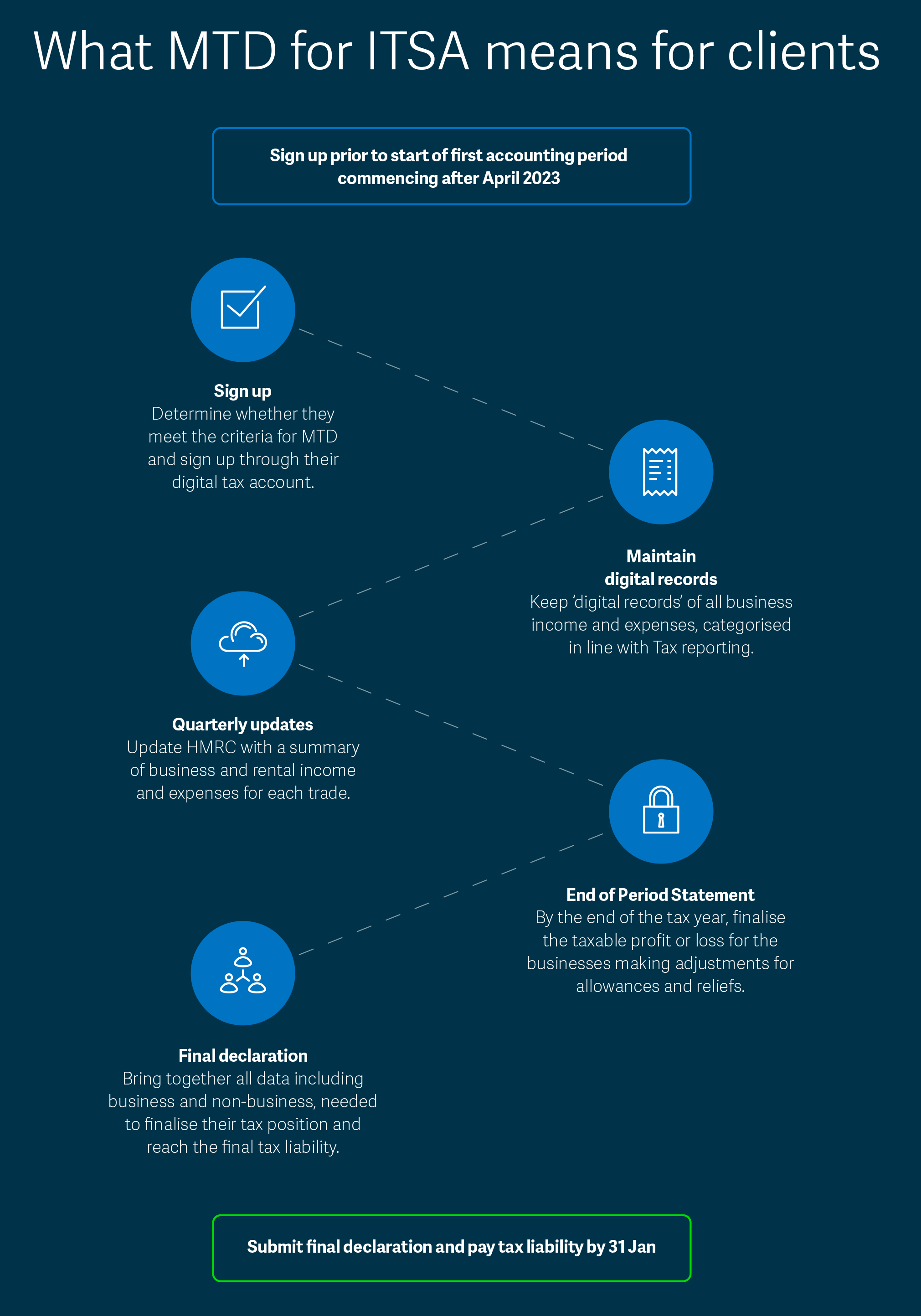
Instead, periodic updates will be made to HMRC using compatible software, as follows:
Quarterly updates for clients for client businesses:
- Defined as: “An electronic submission of summary totals for specified categories from the digital records of each business on a quarterly basis (obligation period) from the software to HMRC.”
- Updates are due from 10 days before, to one month after the quarter end date.
- The update doesn’t need to include a statement that the data is complete and accurate – no tax is paid at this point.
- HMRC returns a calculation of the estimated tax liability based on the information sent. This should be discussed with clients, with potential inaccuracies notified (e.g. pending later adjustments).
- Amendments to previously submitted updates can be made by resending the update for that period in the following period.
End of period statements (EOPS) for client businesses:
- One is required for each client business.
- The EOPS relates to the accounting period or basis period for the business and can’t be completed before the end of that period. It can be completed and submitted at any point after this date and up to the following 31 January.
- Process to finalise the taxable profit or allowable loss for any one source of business, or combined property income.
- The process will pull the information already submitted in the quarterly updates and make adjustments/additional information, such as allowances and reliefs.
- If not already included in quarterly updates, disallowable expenditure must be adjusted for.
- The submission must include a declaration that the information is complete and correct.
- Once submitted, HMRC returns a tax calculation.
Final declaration for clients (crystallisation):
- This is the process to bring together all data needed to finalise the tax position and reach the final tax liability for the client.
- It takes into account all sources of income, gains and losses whether business or otherwise.
- It effectively replaces the SA100 tax return.
- 31 January continues to be the deadline for filing.
- Any income tax liability must also be paid by 31 January.
- HMRC will provide a submission interface to allow filing without the need for software.
- If any information that needs to be included in the final declaration isn’t supported via software submission then the client will also need to complete a Self Assessment tax return.
What information will clients submit for MTD for ITSA (EOPS, quarterly reports, etc)?
The following are non-exhaustive lists and subject to change and confirmation by HMRC.
For a self-employment business the data required is likely to include:
- Business income (e.g. turnover).
- Business expenses (total and disallowable by type of expense, such as travel costs).
- Tax allowances for vehicles and equipment (e.g. capital allowances).
- Adjustments (e.g. basis adjustment).
- Balancing charges.
- Goods and services for client’s own use.
For a property business, the data required is likely to include the following:
- Property business income for both rentals and furnished holiday lettings (FHL).
- Property business expenses (e.g. premises running costs).
- Allowances (e.g. annual investment allowance).
- Adjustments (e.g. loss brought forward).
- Balancing charges.
For the final declaration, the individual is likely to be required to include the following among other things:
- Total UK dividend income for a tax year.
- Taxed UK savings interest.
- Untaxed UK savings interest.
Can clients opt out of MTD for ITSA?
As with MTD for VAT, it won’t be possible for most clients to opt out of MTD for ITSA if they fall within its scope.
However, it’s likely that those who fall under the digital exclusion rules as defined by MTD for VAT will be able to apply to HMRC to be exempted from MTD for ITSA.
This includes people whose disabilities mean they can’t use software, for example, for people whose remote location means internet access is impossible.
What software do clients require for MTD for ITSA?
HMRC says free software will be made available for clients. Notably, it adds that this will be for “the simplest tax affairs”.
Existing cloud accounting software will be updated in time, although this might not necessarily be true for desktop accounting software. You or your clients may need to consult the software vendor to ensure updates and patches are installed in time.
Older software packages that are no longer supported may not be updated, so might require the client migrate their accounting to a different package.
It will be possible to use spreadsheets for MTD for ITSA accounting through the use of either bridging software, or special spreadsheets/worksheets that facilitate digital linking with cloud services.
Remember that the digital linking rules say that copying and pasting is not allowed, and all transfer of MTD for ITSA data must be both digital and automated.
Because of this and other issues, using a spreadsheet is unlikely to be the most user-friendly solution.
Do clients signed up for MTD for VAT need to sign up for MTD for ITSA?
The two MTD schemes for VAT and Income Tax operate independently, with their own sign up criteria.
It isn’t the case that MTD for ITSA applies only to those already using MTD for VAT – although many businesses already using MTD for VAT will find themselves having to sign up for MTD for ITSA too.
What does MTD for ITSA means for accountants?
It’s hard to overstate the changes MTD for ITSA will bring for you. Here are two things to be aware of.
1. Your clients will have to use software
While this might be obvious, it requires exploration and clarity.
Your clients will be required to use compatible software to record their business and property income and expenditure, and send six updates/reports every year to HMRC.
There’s likely to be automation for each of these steps, minimising the administrative impact. But your clients will still need to be aware of the requirements expected of them.
This will require a substantial change in attitude from your clients in how they approach their accounting.
It’s certainly the case that the ‘shoebox’ client who dumps receipts on their accountant’s desk in January each year will have to change their ways.
It’s your role as their accountant to communicate this need for change, and to encourage it to happen.
In return, you are given significant privilege to guide your clients towards the best solution for their needs – and to bring positive changes to their clients’ businesses.
This presents additional opportunities.
Not partnering with a software vendor to sell solutions to your clients, for example, is to discard a potentially large income source.
Needless to say, an MTD for ITSA-compatible cloud accounting solution that ties into your own systems is best for both you and your client.
You can offer training in the software, perhaps as part of the sales package, or as a separate service offering.
At the very least, every UK accountant will need to be proficient in the free software package the government will probably offer, because accountants will be facing client enquiries about this on a very regular basis.
2. You have the opportunity to offer additional advisory services
Although MTD for ITSA should mean clients are more aware of their accounting, it doesn’t mean your fundamental role will change.
You’ll still be required to help your clients be compliant, and to help them with fundamentals such as making deductions and calculating a final income tax bill.
While it’s possible some small business owners may have an epiphany moment when they get to grips with accounting software, and realise the power it delivers, the fundamental fact that many people hate dealing with figures and the ensuing admin burden isn’t going to change.
You have nothing to fear from technology and, in fact, lots to gain.
But this is only scratching the surface of the potential that MTD for ITSA will deliver.
You’ll go from having a single point of contact each year to potentially having at least six situations where your clients may need help with their accounting when they make those quarterly reports, EOPS and the final declaration.
These situations can be used to forge stronger relationships where you’re not viewed as just a number cruncher but more of a business partner.
Using cloud software that ties in with your clients’ accounting gives you the ability to monitor for problems or opportunities, and to provide advice based on this.
MTD for ITSA delivers the potential to take on more of an advisory role. It would certainly be worth taking advantage of this in order to create a practice that’s fit for the 21st century.
Final thoughts on MTD for ITSA
If your practice dealt with the implementation of MTD for VAT ahead of it being mandated in April 2019, you’ll be well aware that starting early with preparations will put you and your clients in good stead.
If it didn’t, the best advice is to start now.
Look at your processes, start talking to your clients and take the steps now to not only meet the requirements for MTD for ITSA but use it as an opportunity to help your practice and your clients really flourish.